Service Summary
In 2026, most homeowners should budget about $900 to $2,500 to install or replace a standard tank water heater, while tankless projects commonly run $1,400 to $3,900. Northern California prices rise when venting, gas lines, electrical service, access, permits, or code corrections are required. A site-specific quote determines the final price.
Why Water Heater Installation Cost Matters to Homeowners
A failed water heater forces a fast decision, which is exactly when homeowners are most vulnerable to an incomplete quote. The unit displayed at a home-improvement store is only one part of the installed price. Labor, removal, disposal, connectors, shutoff valves, venting, electrical work, seismic restraint, drain protection, permit requirements, and testing all affect the actual cost to replace a water heater.
The national data only makes sense when you compare the scope behind each number. Angi reports an average replacement cost of $1,347 and a typical range of $881 to $1,825 for tank-style replacements, while tankless projects run from $1,400 to $3,900.1 Larger tanks, fuel conversions, difficult access, and corrective work can take a project above those averages.
Northern California adds requirements that generic calculators understate. Tank units require earthquake restraint, and older homes in Marysville, Chico, Grass Valley, and Nevada City often have tight closets, dated vents, undersized gas lines, older electrical panels, or noncompliant relief piping.
The goal of this guide is to give you a defensible planning range, explain why bids differ, and show what a complete installation quote should contain. For a property-specific number, review our professional water heater installation service or request an assessment before the current unit fails.
Average Water Heater Price vs. Total Installed Cost
The average water heater price is not the same as the installed project price. The equipment price buys the appliance. The installed price pays for the correct appliance, qualified labor, safe connections, code compliance, removal of the old unit, startup, testing, and responsibility for the finished system.
For planning purposes, these 2026 national ranges provide a practical baseline. They are not a flat price list for Northern California because site conditions and local permit requirements change the scope.1
| Project type | Typical installed planning range | What usually drives the total |
|---|---|---|
| Standard 30- to 50-gallon tank replacement | $900-$2,500 | Fuel type, capacity, access, fittings, venting, and code corrections |
| 75-gallon or high-recovery tank | $1,100-$4,000 | Larger equipment, heavier handling, higher gas or electrical demand |
| Tankless replacement | $1,400-$3,900 | Unit capacity, venting, condensate, controls, and service access |
| Tank-to-tankless conversion | Often above a direct replacement | Gas-line sizing, new vent route, mounting, electrical supply, and repiping |
| Hybrid heat-pump water heater | $1,200-$3,500 | Equipment cost, 240-volt circuit, condensate drain, space, and airflow |
The lower end normally describes a straightforward, like-for-like replacement in an accessible location with usable connections and no major corrections. The upper end reflects larger equipment, premium efficiency, difficult access, power venting, relocation, fuel conversion, or work needed to make the installation safe and compliant.
Unit size alone changes the budget. Angi places a 40-gallon installed project around $800 to $2,300, a 50-gallon project around $800 to $2,500, and a 75-gallon project around $1,100 to $4,000.1 The right choice is not automatically the cheapest tank. An undersized heater that repeatedly runs cold is a bad purchase even when the initial invoice is lower.
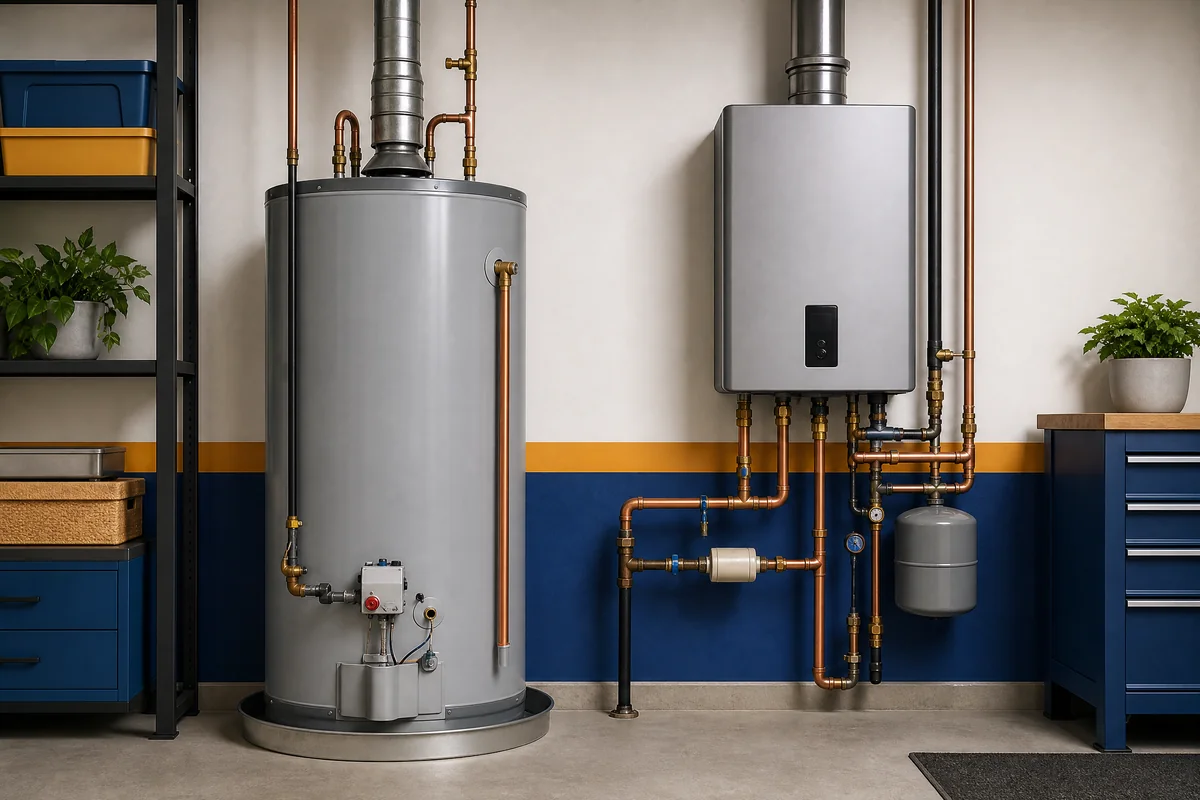
Tank, tankless, and heat-pump systems have different equipment, infrastructure, and maintenance costs.
Cost to Replace a Water Heater by System Type
A standard tank replacement is usually the least complex path because the new unit can often reuse the location, fuel source, vent route, and water connections. Gas models require safe combustion air and venting. Electric tanks eliminate venting, but the circuit and panel must match the equipment. A direct 40- or 50-gallon swap is the benchmark most homeowners have in mind.
A tankless water heater often needs a larger gas supply, dedicated venting, condensate handling, electrical power, isolation valves, and capacity based on simultaneous flow. Replacing an existing tankless unit is different from converting a tank system because a direct replacement can reuse more infrastructure. Review the practical tradeoffs on our tankless water heater service page before comparing bids.
A hybrid heat-pump water heater moves ambient heat into the tank. ENERGY STAR states that a certified model can save a household of four about $600 per year compared with standard electric resistance.2 The higher upfront cost must account for air volume, condensate drainage, temperature, tank size, and often a 240-volt circuit.
The Seven Factors That Change the Final Replacement Price
The fastest way to understand two different quotes is to compare the work behind them. The following factors create most of the spread between a basic replacement and a high-cost installation.
1. Capacity and recovery rate
A 40-gallon tank costs less than a 75-gallon tank, but gallons are not the only sizing metric. First-hour rating, recovery rate, fixture demand, and household routines determine whether the heater can keep up. Tankless systems are sized by flow rate and temperature rise.
2. Gas, electric, propane, or heat pump
A like-for-like fuel replacement usually costs less than a conversion. Moving to gas can require a new gas line and vent; moving to electric can require a new circuit and panel capacity. Rural properties may also use propane or well water.
3. Access and installation location
An open garage installation is faster than a tank in a narrow closet, attic, crawlspace, basement, or detached utility room. Relocation adds piping, venting, drainage, electrical work, and sometimes carpentry; Angi reports roughly $150 to $3,400 depending on complexity.1
4. Venting and combustion requirements
Gas and propane heaters must vent safely. A damaged, undersized, back-drafting, or incompatible vent cannot be reused simply because the new tank fits. Power-vent models also need electricity and cost more than basic direct-vent equipment.1
5. Electrical capacity
Electric tank, tankless, and heat-pump models have different electrical demands. A new breaker, disconnect, cable run, receptacle, or panel upgrade changes the project price. Electric tankless systems can require substantial amperage and are not a sensible conversion until panel capacity is verified.
6. Permits and code corrections
National permit estimates commonly run from $25 to $300, but local requirements control.1 The 2025 California Building Standards Code took effect January 1, 2026, and local jurisdictions can adopt amendments.3 A responsible quote identifies known code work before installation.
7. Urgency, disposal, and warranty level
Emergency scheduling, limited equipment availability, and long travel can increase cost. The quote should state whether removal, disposal, warranty registration, and workmanship coverage are included. A bid that excludes those items is not comparable to a complete replacement.
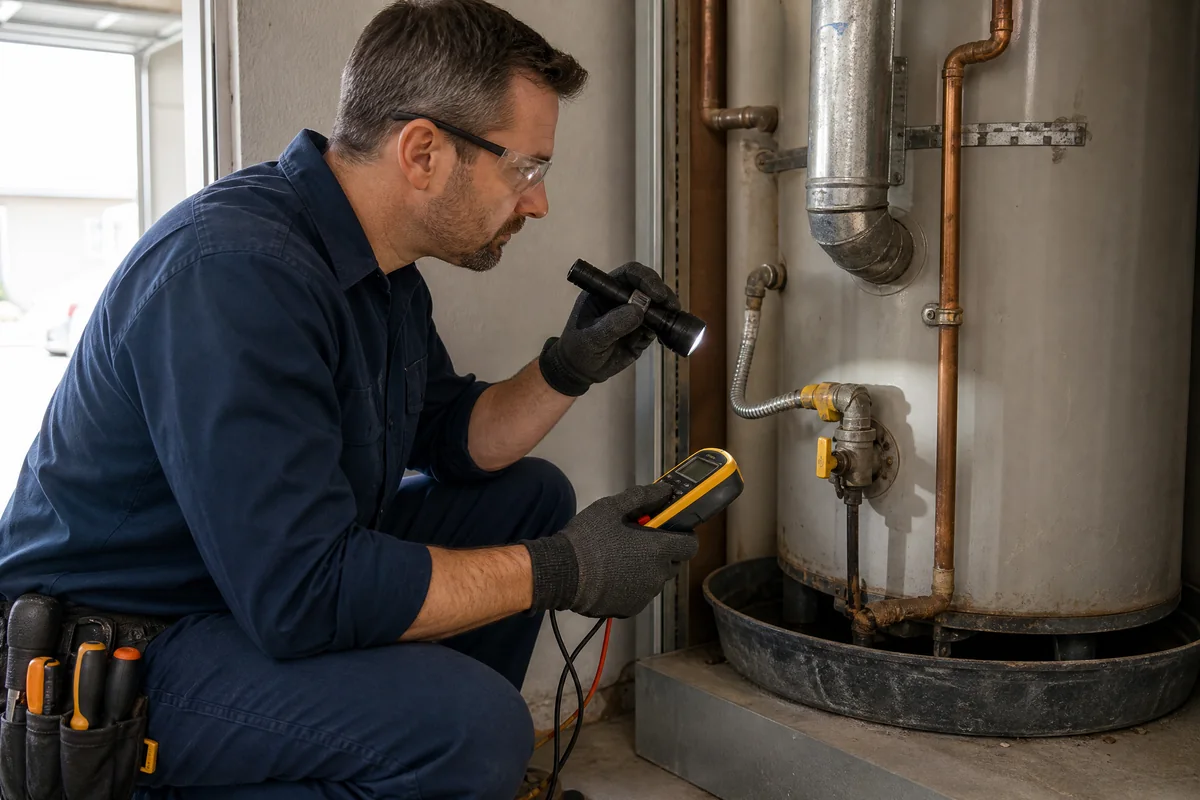
An accurate quote starts with the entire installation—not just the model number on the tank.
What a Complete Water Heater Installation Quote Should Include
A strong quote is specific enough that you can compare it line by line. It should identify the heater type, capacity, fuel, efficiency level, model or equivalent specification, warranty, and expected installation location. It should then define the labor and materials included in the price.
For a standard tank replacement, the scope should address shutdown, draining, removal, disposal, water connections, the cold-water shutoff, relief discharge, venting or electrical connections, seismic restraint, drain protection, startup, and testing. Expansion tanks, pressure regulators, vent corrections, electrical work, or platform repairs should be listed rather than hidden behind “standard installation.”
Ask these questions before approving the work:
- Is removal and disposal of the old water heater included?
- Are the permit and inspection included, excluded, or billed at actual cost?
- Which code corrections are included in the quoted price?
- What condition would legitimately change the price after work begins?
- Is the equipment sized to the household or simply matched to the old tank?
- What manufacturer and workmanship warranties apply?
- Who registers the equipment warranty?
- Is the final system tested for leaks, correct temperature, safe venting, and normal operation?
A verbal number without scope is not a quote. Omitting required work creates an unsafe shortcut or an expensive change order. Our water heater replacement service includes sizing, old-unit removal, installation, and testing.
Northern California Code and Site Conditions That Affect Cost
California water heater work is not a generic appliance swap. The California Seismic Safety Commission states that new and replacement water heaters must be anchored or strapped to resist falling during earthquakes.4 Installers must also address relief discharge, venting or electrical supply, drain protection, combustion air, and manufacturer clearances. Local jurisdictions enforce permits and exact requirements.
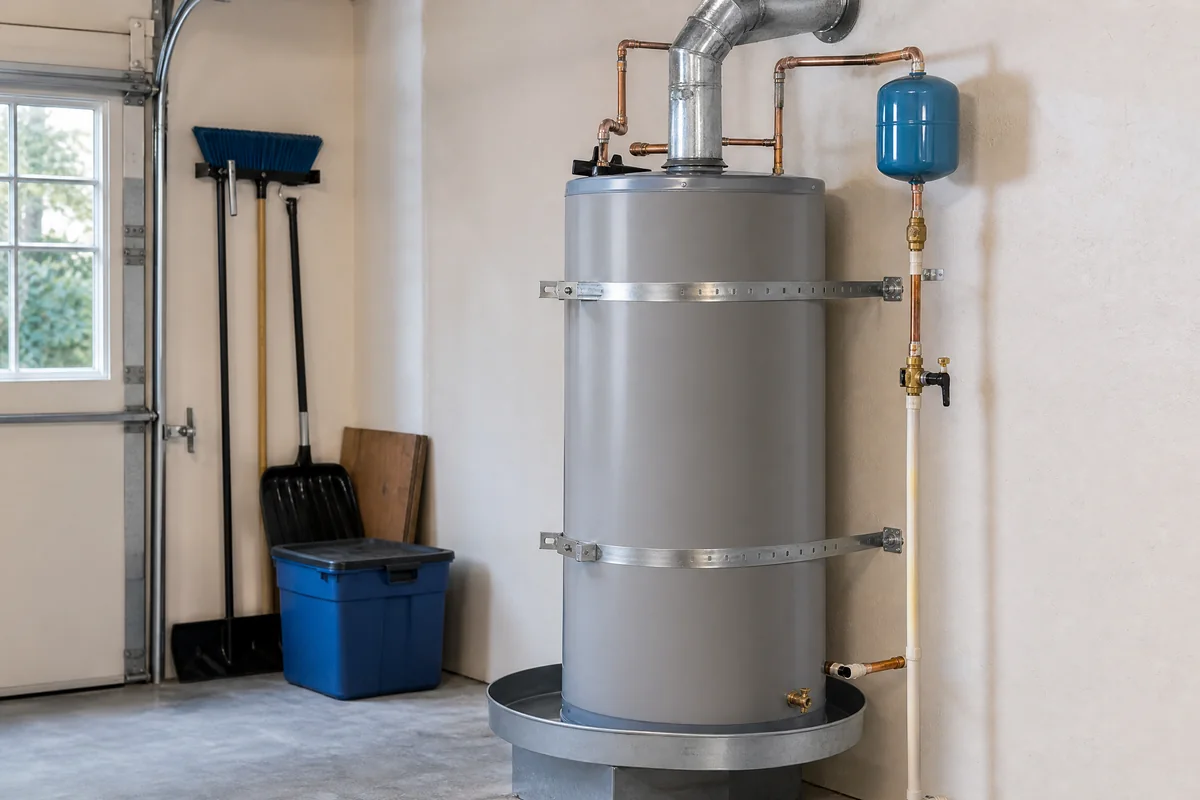
California installation details affect safety, inspection readiness, and the real replacement cost.
Local housing creates additional cost differences. Yuba City water heater customers often have accessible garage installations, but hard valley water contributes to sediment. Chico homeowners have a mix of suburban homes, older properties, and heavily used rentals. Grass Valley water heater projects more often involve wells, propane, older venting, freeze exposure, and tight access.
A direct tank replacement in an open garage is not the same job as a tankless conversion in a basement or a mobile-home-rated installation. Equipment, access, fuel, water quality, and corrections differ. A trustworthy contractor explains those differences.
Hard water affects ownership cost. Sediment reduces usable tank capacity and can accelerate wear, while scale restricts tankless heat exchangers. Annual flushing or descaling belongs in the total cost of ownership.
Repair or Replace: Which Choice Costs Less Over Time?
Replacement is not automatically the right answer. A younger heater with a failed thermostat, heating element, thermocouple, valve, or control can be a strong repair candidate when the tank is sound and the rest of the installation is safe. Start with a focused water heater repair diagnosis when the failure is isolated and the unit has meaningful service life left.
Replacement becomes the better financial decision when the tank itself leaks, corrosion is advanced, hot water is rusty, failures are recurring, the heater is badly undersized, or the unit has reached the end of its practical life. Standard tank water heaters commonly last about eight to twelve years; hard water and poor maintenance can shorten that range. Tankless units can last longer, but they require regular descaling and can have higher repair costs.
Compare the repair cost, replacement cost, likely remaining life, and operating cost. A modest repair can make sense on a six-year-old heater. The same repair on a corroded twelve-year-old tank is weak economics because the vessel can still fail shortly afterward.
Do not use a rigid “50% rule” alone. Safety, leak location, parts availability, warranty, installation defects, and household demand matter.
Can You Install a Water Heater Yourself to Save Money?
A homeowner can compare models, photograph the installation, clear access, and locate the data plate. Installation is not a smart DIY cost-cutting project when it involves gas, venting, high-amperage wiring, pressurized hot water, a relief valve, seismic restraint, or a permit.
Incorrect venting can create carbon-monoxide exposure. An improper relief line can make a pressure event more dangerous. A poorly supported tank can move during an earthquake, and wrong wire or breaker sizing can overheat. Noncompliant installation can also affect warranty coverage.
If you smell gas, leave and contact the gas utility or emergency services from a safe location. For an active leak, shut off the cold-water supply and energy source only when safe. Never cap a relief line, bypass a safety control, or repeatedly reset a breaker.
Professional installation pays for sizing, code compliance, safe startup, testing, and responsibility for the finished system.
Frequently Asked Questions About Water Heater Installation Cost
How much does it cost to replace a 50-gallon water heater?
A 50-gallon replacement commonly runs about $800 to $2,500 nationally, depending on fuel, access, equipment, venting, permits, and code corrections.1 Northern California projects need earthquake restraint. A site review sets the final price.
Is a tankless water heater more expensive to install?
Yes. A tankless replacement commonly runs about $1,400 to $3,900, and a conversion often costs more because it can require a larger gas line, venting, condensate drainage, electrical supply, isolation valves, and repiping.1
How much of the total cost is labor?
Labor covers draining, removal, equipment handling, connections, code items, startup, and testing. Angi estimates $150 to $450 for basic tank replacement labor and $600 to $1,900 for tankless replacement labor, with regional and scope differences.1
Does homeowners insurance pay for water heater replacement?
Insurance generally does not replace equipment that fails from age, wear, corrosion, or poor maintenance. A policy may cover resulting damage from a sudden covered event, subject to exclusions and the deductible. Confirm coverage with the carrier.
How can I keep the replacement cost under control?
Plan before failure. Photograph the label and installation, get a written scope, compare equivalent equipment, and confirm permits and disposal. If you have an aging electric tank, check current utility incentives for a heat-pump model before an emergency removes your time to compare.2
Need Water Heater Installation in Northern California? Water Heater Specialists Is Ready to Help
Water Heater Specialists installs and replaces tank, tankless, gas, electric, propane, and heat-pump water heaters across Yuba City, Chico, Grass Valley, and surrounding Northern California communities. The team sizes the equipment, explains the full scope, removes the old unit, completes required installation details, and tests the finished system.
Call Yuba City at (530) 370-7729, Chico at (530) 868-8838, or Grass Valley at (530) 768-2105, or contact Water Heater Specialists to request an installation or replacement quote.
References
- Angi: 2026 water heater replacement cost data
- ENERGY STAR: Super-efficient heat-pump water heater guidance
- California Building Standards Commission: Current state codes
- California Seismic Safety Commission: Water heater strapping requirements
Get a Complete Water Heater Installation Quote
Call your nearest market for fast, focused service from Water Heater Specialists.